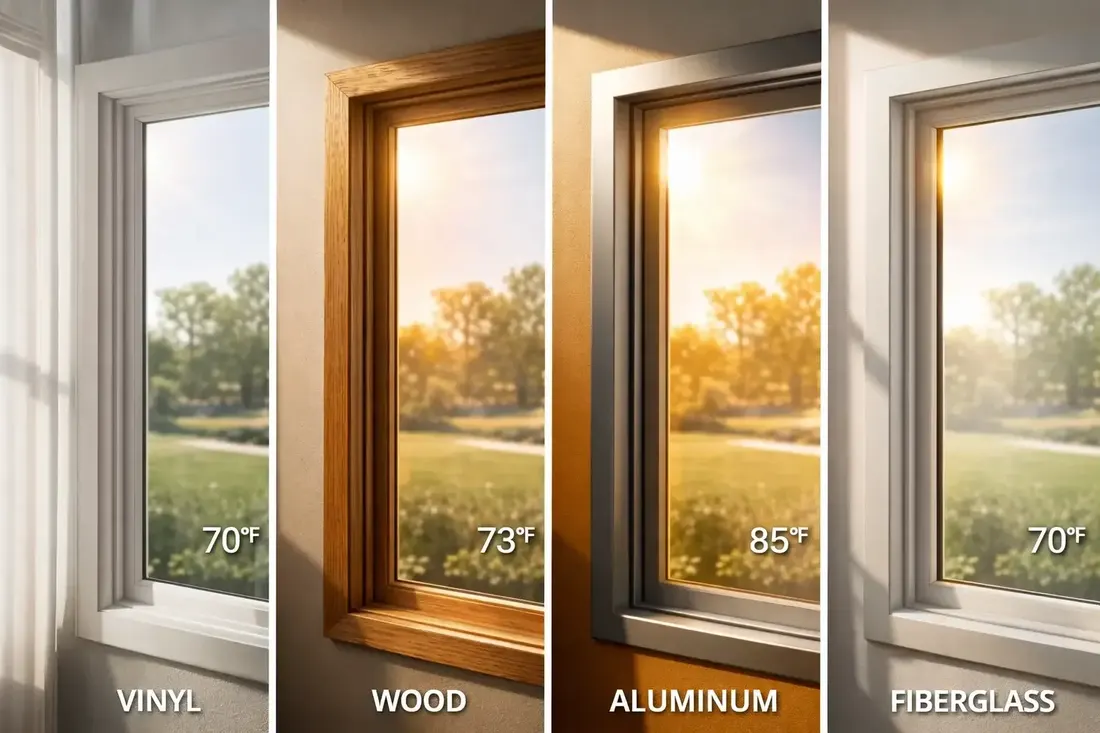
U-factor and SHGC are the two main numbers on a window’s NFRC label. U-factor is how fast heat flows through the window, and SHGC is how much of the sun’s heat gets through the glass. Lower is better for both, and in North Texas the sun number deserves extra weight.
The short answer
- U-factor measures heat flow through the window, and SHGC measures sun heat passing through the glass.
- U-value and U-factor are the same number, and lower is better for both U-factor and SHGC.
- Compare whole-window label values for the same size and type, not brochure numbers for the glass alone.
- A low SHGC pays off most on west and south walls, so weight it more in North Texas.
- A very low SHGC can reduce daylight, so check visible transmittance as well.
- Look up the ENERGY STAR criteria for your own county at the source, because the values can change.
U-factor is a measure of how fast heat moves through a window, and the Solar Heat Gain Coefficient, or SHGC, is the share of the sun’s heat that passes through the glass into the room. You will also see U-factor called U-value. It is the same number. Both appear on the label that the National Fenestration Rating Council puts on a rated window, and together they tell you more than any brochure.
What do U-factor and SHGC measure?
U-factor measures heat flowing through the whole window because of a temperature difference, such as a hot afternoon outside and a cool room inside. SHGC measures the heat that arrives because the sun is shining on the glass. One is about temperature difference and the other is about sunlight.
- U-factor: a lower number means the window slows heat flow better. It matters in summer and in winter.
- SHGC: a lower number means less of the sun’s heat gets in. It matters most on walls that take direct sun.
- R-value runs the other way, because a higher R-value insulates better. A window label shows U-factor, not R-value, so do not compare the two directly.
Think of U-factor as the window’s insulation and SHGC as its sunshade. A good window needs both, and the right balance depends on the wall. Our post on choosing energy-efficient windows shows how to set that balance for each side of the house.
What else is on a window label?
Besides the two main numbers, the label can list visible transmittance, air leakage and condensation resistance. The last two are optional on some labels, so you may not see them. They tell you about daylight, tightness and moisture, and they are worth a look when you compare two windows.
| Rating | What it measures | Which direction is better |
|---|---|---|
| U-factor | Heat flow through the whole window | Lower |
| SHGC | Share of the sun’s heat that gets through the glass | Lower in a hot climate |
| Visible transmittance | How much daylight passes through | Higher gives more light |
| Air leakage | How much air passes through the closed window | Lower is tighter |
| Condensation resistance | How well the window resists condensation on the inside | Higher resists it better |
The National Fenestration Rating Council runs the rating system behind the label. The label rates the complete product, which is why the numbers belong to a specific window, size and glass package. A different size of the same window can carry slightly different numbers.
How do you compare two windows with these numbers?
Put the two labels side by side and ask which number matters most on the wall in question. Suppose Window A has the lower U-factor and the higher SHGC, and Window B has a slightly higher U-factor and a much lower SHGC. On a west wall in Dallas, B is probably the better fit. On a shaded north wall, A may win.
Three habits keep the comparison honest. Compare the same size and type of window. Compare whole-window numbers, since some brochures give a figure for the glass alone. And do not chase the single lowest number. A very low SHGC can also lower the daylight a window lets in, so check visible transmittance too.
- List each window with the direction its wall faces.
- Ask the company for the label values of the exact window and glass it proposes for each one.
- On sun-facing walls, rank the options by SHGC first and U-factor second. On shaded walls, reverse the order.
- Check visible transmittance so that the rooms do not go dim.
- Check the frame and the installation plan, since a number on paper does not seal an opening.
None of this needs special tools. It needs the labels, a pencil and a floor plan. If a salesperson cannot show you the label values for the window being offered, treat that as a gap in the estimate and ask again in writing.
Why does SHGC get so much weight in North Texas?
Because the cooling season here is long and the sun is strong. After the summer of 2023, many homeowners in Fort Worth and Plano could say exactly which room would not cool. That is usually a west or south room with a lot of glass, and it is where a low SHGC pays off most.
U-factor still counts. The freeze in December 2022 was a reminder that this region has real cold snaps, and a tight, well-insulated window helps then too. The balance leans toward SHGC for hot walls and toward U-factor for shaded ones. Our post on window frame materials in Texas heat covers how the frame feeds into both numbers.
Where do you find the right targets for your county?
ENERGY STAR sets window criteria by climate region. Its key product criteria page is where to look up the region for your county and the values it uses. We do not print those values here, because they are set by the program and can change. Read them on the source.
The U.S. Department of Energy’s window page is a good plain-language companion. Ask the window company to show you the label for the exact window and glass you are buying. Our post on energy-saving window options for Texas summer and winter goes through the choices.
American Eagle Builders installs Andersen windows in the 100, 400, A-Series and E-Series lines. You can see them on our windows page, and we offer free in-home estimates in Dallas–Fort Worth. We can show you the label values for the windows we propose, so that you can compare us with anyone else.
Questions we get asked about this
Yes, they are the same number. The National Fenestration Rating Council uses the term U-factor on its labels, and many people say U-value. Both measure how fast heat flows through the window. Lower means better insulation. R-value runs the opposite way, so do not compare it directly.
It stands for Solar Heat Gain Coefficient. It is the share of the sun’s heat that passes through the window into the room, on a scale from zero to one. A lower SHGC lets in less sun heat, which helps on hot, sunny walls in North Texas.
Both matter, but SHGC deserves extra weight on walls that take direct afternoon sun, since our cooling season is long. U-factor still helps in the cold snaps and on shaded walls. Compare the label values for the whole window, wall by wall.
Yes, in the sense that a very low SHGC can also reduce the daylight the window lets in. Check the visible transmittance on the label as well. The best choice balances sun control and light for the room you are working on.
Ask us for the NFRC label values for the exact window and glass we propose. American Eagle Builders offers free in-home estimates across Dallas–Fort Worth and installs Andersen windows, so you can compare our numbers with other estimates side by side.